Copyright © 2026 GBMF, LLC d/b/a Artiva Tile, All rights reserved.

Copyright © 2026 GBMF, LLC d/b/a Artiva Tile, All rights reserved.


A bathroom remodeling quote should tell you what you are buying, what you still need to choose, and what could change the final price. A total without those details leaves too much uncertainty for a project that affects your home every day.
If you are researching bathroom remodel cost in Miami, start by defining the work. Replacing a vanity and refreshing finishes is a different project from rebuilding a shower, moving plumbing, and installing large porcelain panels. Even two bathrooms with the same floor area can require very different budgets.
Here is how to establish a useful starting point, compare estimates, and keep decisions under your control.
National research offers context, but it cannot price your particular Miami bathroom. In the 2026 U.S. Houzz & Home Study, page 18, median spending in 2025 on major primary bathroom remodels was $18,000 for rooms smaller than 100 square feet and $30,000 for rooms of 100 square feet or more. Houzz defines a major remodel here as one that replaces at least the cabinetry or vanity, countertops, and toilet. The study includes projects completed with professional help and DIY work.
These are national survey medians, not Miami price ranges or Artiva Tile estimates. A custom shower, extensive preparation, plumbing changes, premium materials, and building access requirements can change the scope substantially. Use the figures to frame questions, then obtain a written proposal based on your room.
Before requesting estimates, choose the closest description of your project.
These are planning categories, not fixed packages. Write down your priorities: a larger shower, easier cleaning, more storage, better lighting, or replacing a bathroom that no longer functions well. That list helps you spend on the improvements you will notice every day.
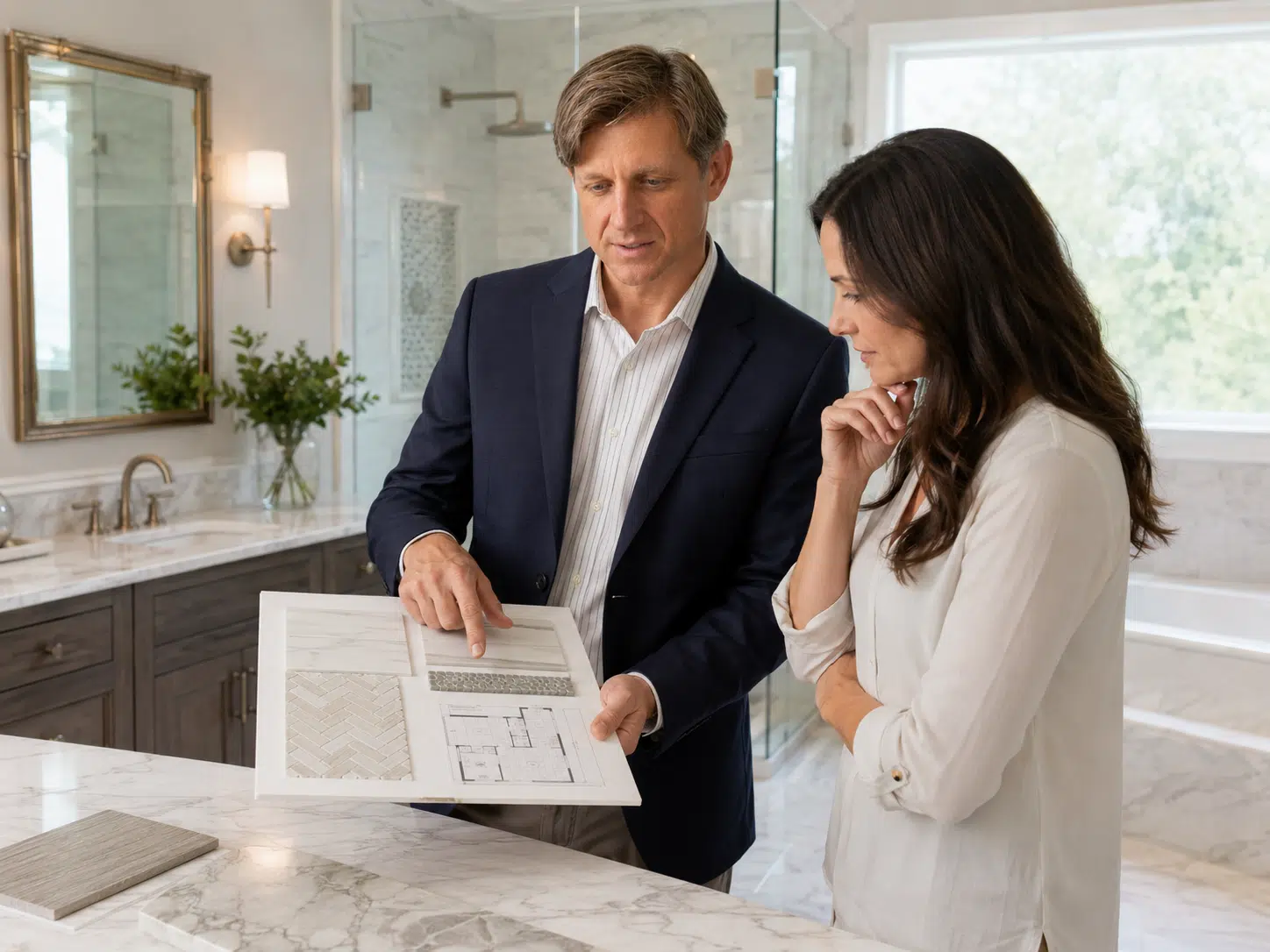
Bathroom material selections help define the project scope and budget before a detailed remodeling quote is prepared.
Keeping or changing the layout
Keeping fixtures in their current locations may simplify the work. Moving a toilet, shower drain, or vanity can introduce additional plumbing and coordination. Ask what has been confirmed during the site visit and what remains subject to investigation.
A new layout may be worthwhile. The important decision is whether the improvement in daily use justifies the additional work.
The existing tile does not reveal every condition behind it. Once demolition begins, the team may find damaged backing, an unsuitable surface, or a shower assembly that needs more extensive rebuilding than expected.
Ask the estimator to distinguish between preparation already included and concealed conditions that cannot yet be confirmed. A useful proposal explains how discoveries will be documented and priced.
Material price per square foot is only one part of the tile budget. Layout, wall coverage, niches, edge finishes, and the handling of large pieces also affect the work.
If your design includes large porcelain tile or slabs, discuss the preparation and installation requirements before purchasing. Our guide to large-format tile installation problems explains why the supporting work deserves attention alongside the visible finish.
A proposal based on a standard vanity is difficult to compare with one allowing for a custom unit. The same applies to shower glass, faucets, mirrors, lighting, and accessories.
For luxury bathroom remodeling, the coordination between these elements deserves its own review. A floating vanity, wall-mounted fixtures, and custom glass may affect more than the purchasing list.
Choose exact products where possible. Otherwise, ask for a clearly stated allowance and confirm whether it covers delivery, installation, and related components.
Use this list when reviewing proposals. Each item should be identified as included, excluded, optional, or subject to a stated allowance.
For work involving plumbing or electrical alterations, confirm permit requirements with the department serving your address. Miami-Dade's permit guidance distinguishes regulated alterations from some surface treatments and notes that municipalities have their own building officials.
An allowance is a placeholder for a selection that has not been finalized. If the vanity you choose costs more than the allowance, the difference needs to be accounted for. Ask whether the allowance includes all the associated items or only the product itself.
An exclusion is work or a purchase outside the quoted total. An excluded shower enclosure or owner-supplied faucet still belongs in your overall project budget.
A change order records an adjustment to the agreed work. It might follow your decision to upgrade a fixture or the discovery of a concealed condition. Ask for the revised scope, price, and schedule effect in writing before authorizing the additional work.
For example, changing a shower valve after the wall has been closed can involve more than buying a different fixture. Resolving the selection before installation gives you a clearer decision.
Use four lines in your planning worksheet:
Avoid counting an allowance twice. If the contract already includes it, add only an expected difference above that allowance. Discuss the reserve after the site review; the uncertainty in an older shower may differ from that in a bathroom with accessible, documented construction.
Before accepting a lower estimate, check whether it covers the same work as the others. A price difference becomes meaningful when you can explain it line by line.
A defined scope and selected products make fixed pricing easier to establish. Read the proposal's allowances, exclusions, and concealed-condition terms so you understand what the quoted price covers.
A smaller room can reduce material quantities, but the shower, plumbing, glass, and coordination still matter. Compare scope as well as square footage.
Finalize important selections early, compare equivalent scopes, and approve changes in writing. If you need to reduce spending, ask for clearly priced alternatives and understand how each changes the result.
Explore Artiva Tile's complete bathroom remodeling in Miami.
Request a free consultation to discuss your space, priorities, and proposed work.