Copyright © 2026 GBMF, LLC d/b/a Artiva Tile, All rights reserved.

Copyright © 2026 GBMF, LLC d/b/a Artiva Tile, All rights reserved.

I design showers and manage bathroom remodels at Artiva Tile. Our company has been working in condos and private homes since 2003, and we typically build two or three showers a month.
When a tile shower fails, the tile is rarely the real problem. What matters is what happened underneath it, in the layers nobody sees once the job is finished.
Redoing a shower can cost anywhere from $1,000 to $10,000, depending on the materials and how complicated the bathroom is. That is expensive for a homeowner and expensive for a contractor. So we would rather build it right once. Our system, our process, and our years of experience let us deliver a shower that won't need to be redone and is built to last for decades.
Here is how that system works, where we see it go wrong, and what we do on every job.
Grout is a porous material, so water gets through it and into the mortar bed below. That is normal. In a conventional shower, the waterproofing is not the tile. It is the shower pan liner underneath, which catches that water and sends it to the drain.
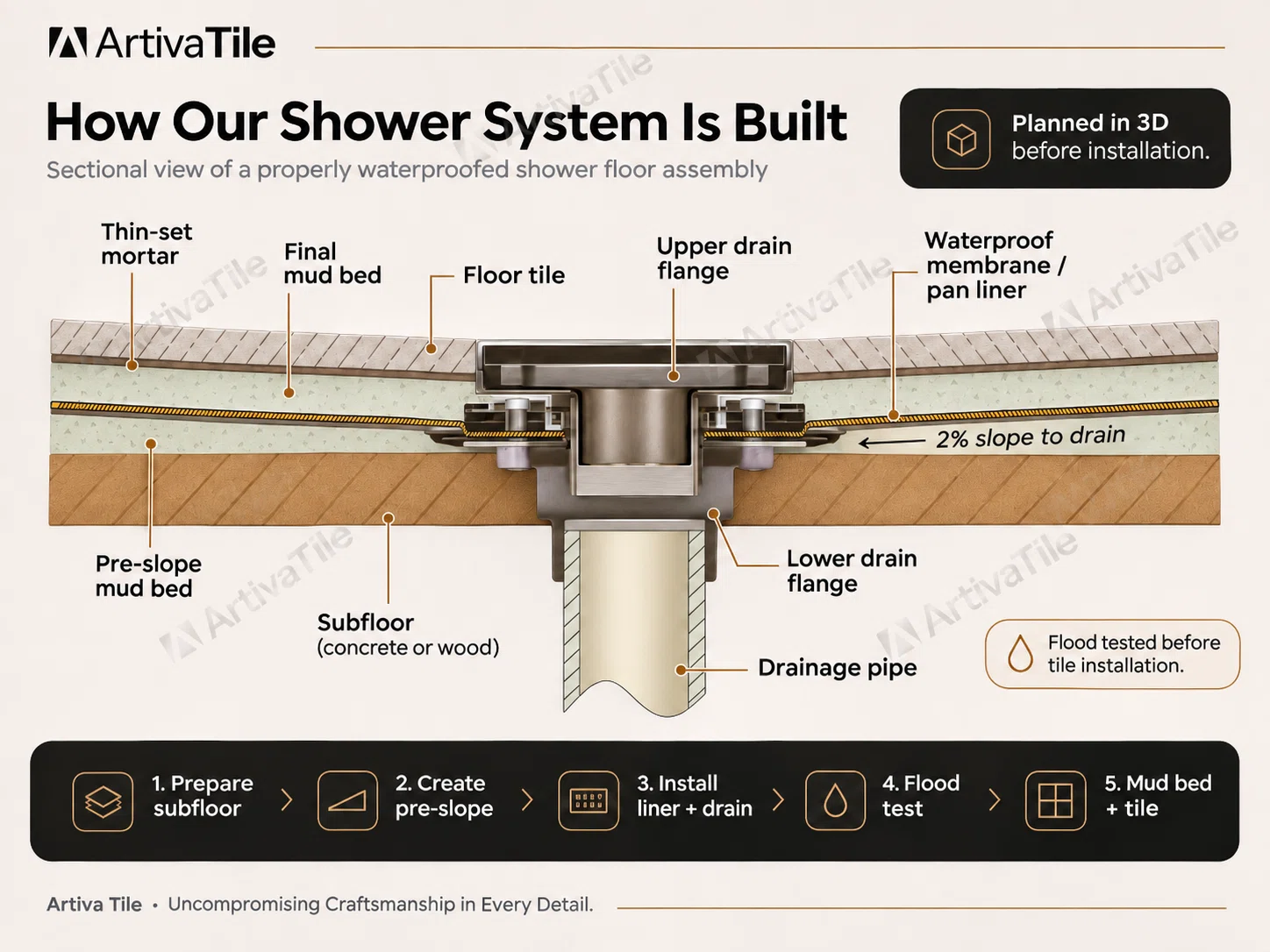
The layers go in this order: supported base, pre-slope, pan liner, mortar bed, tile. A surface-bonded membrane is a different assembly, so its parts and drain details have to match that method.
The same mistakes keep coming up:
The last one is worth remembering. A passed test only tells you the liner was good on the day you tested it.
A liner laid over a flat base holds water, even when the finished shower floor slopes correctly. So before the liner goes in, we form a smooth, solid base that falls a quarter inch per foot toward the drain.
We follow the building code on every job and we don't take shortcuts. The Florida Building Code, Residential (8th Edition, 2023) specifies this slope in Section P2709.3. The 9th Edition takes effect December 31, 2026, so the applicable edition depends on when the permit application is filed.
A liner needs proper backing, carefully folded corners, and a watertight connection at the drain. The Florida Building Code recognizes ASTM D4551 for PVC liners and ASTM D4068 for CPE liners. Plumbing Code Section 421.5.2 requires approved backing and a liner that turns up at least 2 inches above the finished threshold. Manufacturer instructions may ask for more.
In one- and two-family homes and townhouses, Section P2709.1 of the Florida Building Code, Residential sets the curb top 2–9 inches above the drain top. The reference point is the drain, not the bathroom floor. A finished threshold must also sit at least 1 inch below the sides and back of the receptor.
We work in a lot of condos, and those projects can fall under the Florida Building Code, Plumbing instead. Curbless and accessible showers need their own compliant details too, so we confirm the requirements for each project.
You may also see a UPC or cUPC mark on shower products. UPC stands for Uniform Plumbing Code. The mark shows product certification, and cUPC covers applicable U.S. and Canadian requirements. Neither replaces Florida's installation rules.
Real Project. Real Craftsmanship. By Artiva Tile.
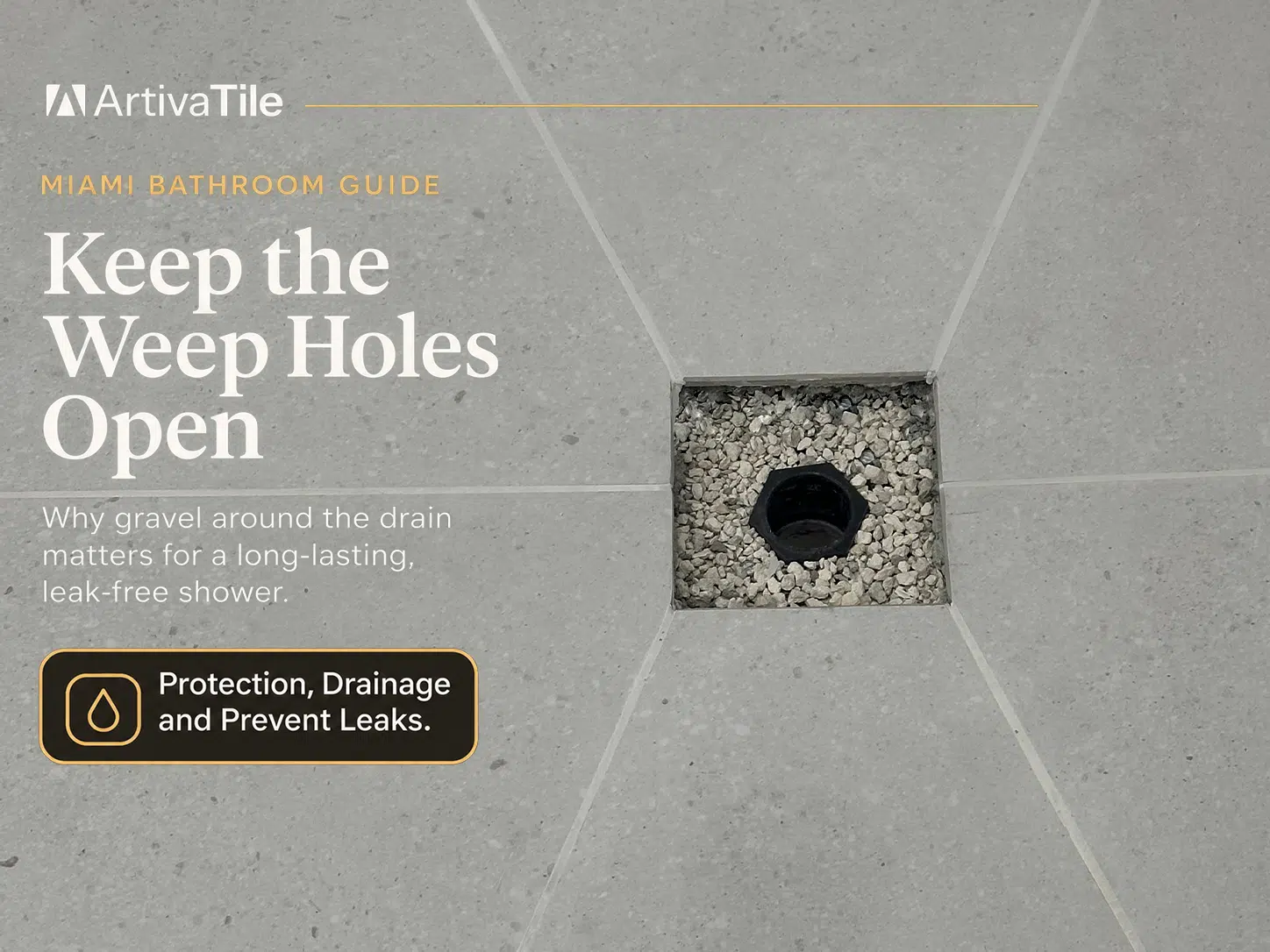
In a conventional liner assembly, the liner connects to a clamping drain. Small passages called weep holes let water leave the mortar bed. If they get blocked, the water stays under your tile.
This is why we place gravel and small stones around the weep holes. They keep the holes open while mortar and adhesive go in during tile installation. The TCNA B414 installation method calls for this kind of protection.
The pan is only one part of the shower. Walls, niches, and pipe penetrations need moisture protection that works with the same assembly. Our guide to why Miami showers leak covers more common failure points.
Real Project. Real Craftsmanship. By Artiva Tile.
Our first check is an overnight water test after the liner and drain connections are installed. We plug the drain, fill the pan, mark the water level, and compare it the next day. Any unexplained drop gets investigated before work continues.
The code minimum is shorter. Section P2503.6 of the Florida Building Code, Residential calls for plugging the drain and holding at least 2 inches of potable water, measured at the threshold, for at least 15 minutes with no evidence of leakage. Condos and other buildings outside the Residential code use the Plumbing code's test, Section 312.9. Manufacturer instructions and inspection requirements still apply.
Then we go further. While the walls are being installed, we cover and protect the liner. After the walls are in, and before the shower floor tile goes down, we run a second water test. That way we know nothing was damaged during installation.
A second test costs us time. A redo costs far more, and it costs the client their bathroom all over again.
Miami's humidity is a separate issue from the water under your tile. Bathroom ventilation manages humid air, and the liner manages liquid water. You need both. EPA recommends keeping indoor relative humidity below 60 percent if possible, ideally between 30 and 50 percent.
Not the tile. Grout is porous, so water gets through it. A conventional shower stays dry because of what's underneath: a pre-slope, a pan liner, a watertight drain connection, and open weep holes. If one of those fails, a shower can look perfect and still have a problem.
In the showers we see, it's usually a missing pre-slope or blocked weep holes. Both leave water sitting under the tile, which can cause odors and stains on natural stone. Badly folded corners, a wrong curb height, and a liner damaged after its water test can also lead to leaks.
We test it twice. First, we leave water in the pan overnight after the liner and drain are installed. Then, after the walls are in and before the floor tile goes down, we test again. Wall work is when an unprotected liner can get damaged.
For homes and townhouses, the Florida Building Code, Residential calls for a liner sloped a quarter inch per foot and turned up at least 2 inches above the finished threshold. The curb must sit 2–9 inches above the drain top. The test holds at least 2 inches of water for at least 15 minutes. Condos can fall under the Plumbing code. The 9th Edition takes effect December 31, 2026, so check which edition applies to your permit.
A redo can cost $1,000 to $10,000, depending on the materials and the bathroom. That's why we build to last for decades. Since 2003, no client has come to us because a system we installed leaked. Our warranty is one year, with a 10-year extended option.
Since we started in 2003, we have not had a single client come to us because a system we installed leaked. Our standard warranty is one year, and an extended 10-year warranty is available.
Before you approve any shower tile installation, ask your contractor five questions:
If you're planning a remodel, talk with Artiva Tile about your complete bathroom. We'll build these details into the plan from the beginning.