Copyright © 2026 ArtivaTile by GBMF, LLC - All rights reserved.

Copyright © 2026 ArtivaTile by GBMF, LLC - All rights reserved.

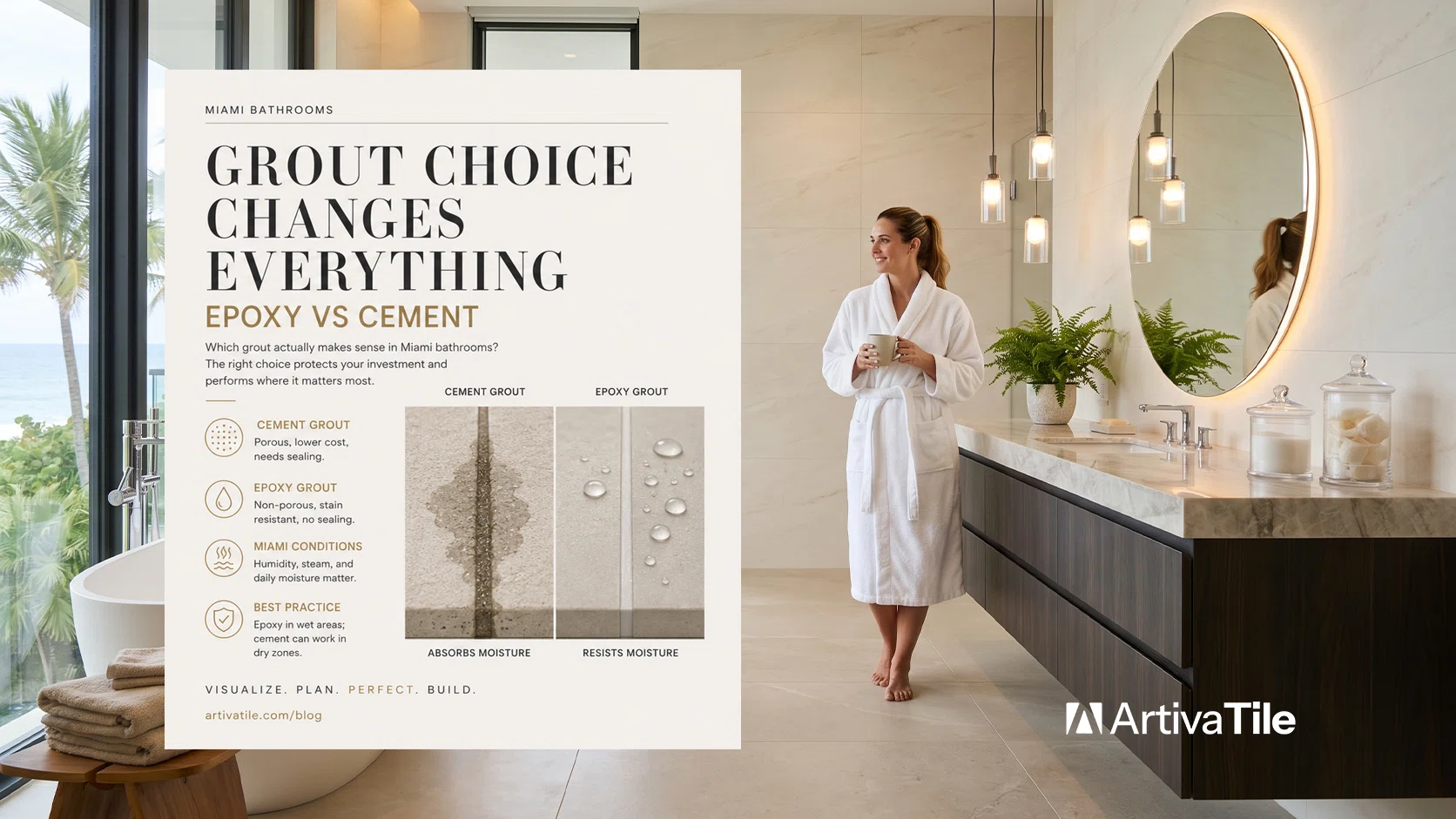
Homeowners often assume grout is just a color choice.
In reality, grout is one of the most important performance decisions in a Miami bathroom.
Because South Florida bathrooms live in constant humidity, steam, and daily moisture exposure, the type of grout you choose directly affects:
The big question we hear most:
“Should I use epoxy grout or cement grout in my Miami bathroom?”
The honest answer is:
It depends on the project, the usage, and the system behind the tile.
Bathrooms in Miami experience conditions that are far harsher than in many other regions:
This environment is exactly what traditional grout struggles with.
So understanding the difference between grout types is critical.
Cement-based grout is the most common grout used in tile installations.
Cement grout is:
Even high-quality cement grout needs ongoing maintenance to stay clean and mold-free in South Florida conditions.
Epoxy grout is a completely different material.
Instead of cement, it uses resin-based binders that create a dense, non-porous joint.
For Miami bathrooms, these benefits are significant.
Epoxy grout isn’t necessary for every project—but in certain situations, it makes perfect sense:
✔ Master showers used daily
✔ Steam showers
✔ Niches and benches
✔ Wet floors
✔ Light-colored grout lines
✔ Homes with limited ventilation
Anywhere moisture exposure is heavy and consistent, epoxy grout dramatically reduces long-term maintenance headaches.
Epoxy grout is premium—but it’s not always required.
Cement grout can be a practical choice for:
The key is choosing the right grout for the right location—not forcing one product everywhere.
One important detail homeowners often miss:
Epoxy grout is much more technique-sensitive to install.
It requires:
Installed incorrectly, even epoxy grout can look messy or perform poorly.
That’s why product choice must always be paired with skilled workmanship.
In Miami’s humid climate, epoxy grout typically means less maintenance and fewer problems over the life of the bathroom.
At Artiva Tile, we don’t choose grout in isolation.
We look at the entire installation as a system:
Grout is just one layer of that system—but it has to match everything around it.
Even the best epoxy grout cannot compensate for:
That’s why we focus on building complete, high-performance assemblies—then selecting the grout that best supports that system.
For most South Florida projects, our general guidance is:
This balanced approach delivers performance without unnecessary cost.
Before any tile or grout is installed, we digitally plan:
This ensures the final result looks intentional and performs correctly.
👉 Related Service: /services/large format tile and slab
👉 Ready to plan your project? /contact
Q: Is epoxy grout better than cement grout?
In wet Miami bathrooms, epoxy grout usually performs better because it is non-porous and highly resistant to mold and stains.
Q: Does epoxy grout need to be sealed?
No. Unlike cement grout, epoxy grout does not require sealing.
Q: Is epoxy grout harder to install?
Yes. It requires more experience and precise technique, which is why professional installation is important.
Q: Can I use cement grout in a Miami shower?
Yes, but it will require regular sealing and more maintenance compared to epoxy.
Q: Is epoxy grout worth the extra cost?
For heavily used showers and wet areas in South Florida, it is often one of the best long-term upgrades.
Q: Which grout resists mold better?
Epoxy grout offers far superior resistance to mold and mildew.
Q: Does grout choice affect waterproofing?
Grout is not waterproof. The waterproofing system behind the tile is still the most critical layer.
We evaluate every project based on real Miami conditions—not generic recommendations.
👉 Contact us for a system-first consultation: /contact